![[EXT]](images/offsite.png)
SDSS-III
Building on the Legacy of the Sloan Digital Sky Survey (SDSS) and SDSS-II, the SDSS-III Collaboration is working to map the Milky Way, search for extrasolar planets, and solve the mystery of dark energy.
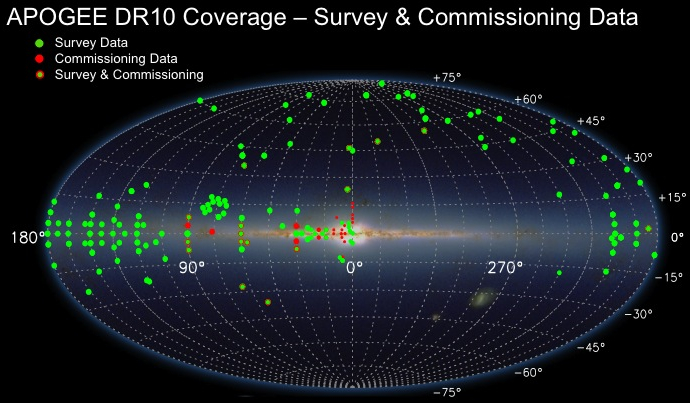
SDSS-III's newest release is Data Release 12 (DR12). DR12 contains the final data from SDSS-III, including the first spectra of the Multi-object APO Radial Velocity Exoplanet Large-area Survey (MARVELS), additional data from the APO Galactic Evolution Experiment (APOGEE), as well as additional sky coverage and better galaxy parameter estimates from BOSS.
The SDSS has continued through a fourth phase, and is currently observing in its fifth phase. The most recent SDSS data release is Data Release 19.
All of the SDSS-III's images, spectra, and measurements are available to anyone online. You can browse through sky images, look up data for individual objects, or search for objects anywhere using any criteria.
Data releases are cumulative, so all previously-released images, spectra, and measurements are still available in DR12. To enable direct comparison with prior studies, we continue to host all prior data releases. The SDSS-III's prior releases, Data Release 10, Data Release 9 and Data Release 8, are available from this site. Older data releases are available from the original SDSS website, classic.sdss.org.
SDSS-III Surveys
SDSS-III began to collect data in 2008, and will continue until 2014, using the Sloan Foundation 2.5-meter Telescope at Apache Point Observatory in New Mexico. SDSS-III consists of four surveys, each focused on a different scientific theme. Click on one of the images below for more information about each survey.
 |
 |
 |
 |
The SDSS-III Collaboration
The SDSS-III Collaboration includes many institutions from around the globe. Inquiries from interested parties to join the collaboration are welcome. For a detailed description of SDSS-III, see the Project Description, available as a PDF document.
Funding for SDSS-III has been provided by the Alfred P. Sloan Foundation, the Participating Institutions, the National Science Foundation, and the U.S. Department of Energy Office of Science. The SDSS-III web site is http://www.sdss3.org/.
SDSS-III is managed by the Astrophysical Research Consortium for the Participating Institutions of the SDSS-III Collaboration including the University of Arizona, the Brazilian Participation Group, Brookhaven National Laboratory, Carnegie Mellon University, University of Florida, the French Participation Group, the German Participation Group, Harvard University, the Instituto de Astrofisica de Canarias, the Michigan State/Notre Dame/JINA Participation Group, Johns Hopkins University, Lawrence Berkeley National Laboratory, Max Planck Institute for Astrophysics, Max Planck Institute for Extraterrestrial Physics, New Mexico State University, New York University, Ohio State University, Pennsylvania State University, University of Portsmouth, Princeton University, the Spanish Participation Group, University of Tokyo, University of Utah, Vanderbilt University, University of Virginia, University of Washington, and Yale University.
 |
 |
 |